
Can only a tree launch such an onslaught, standing suddenly and confronting the world with the grandeur of its greening? After the long winters, the hailstorms, the snow, the barren stretches, the solitary standing in the freezing moments—how profound is the faith of the tree in simply remaining rooted!
It is this faith that shatters time, cradling the sun in its embrace. Branches stretched wide, green and infinite, welcoming the rain’s kisses…
But let us not think of the tree. I think instead of a kiss—a girl who, for the first time, kisses her beloved on the street and then blossoms, becoming fruitful and magnificent. I think of the street, where I have never kissed anyone. How mournful the trees of our streets must be, for they have never witnessed a girl’s kiss under the shadows of the trees …
Mournful.
This is a mournful Afghanistan a land without kisses in the streets. Yet it is a luxurious kind of sorrow.
A kiss is a venomous longing when the arms of the street are entwined with death and the roots of its trees float in blood.
Here, no hand even in dreams plants a tree in the city. Hands have abandoned themselves. They carry no scent of grass, no hint of greenery, no trace of growth. Hands have turned trees into coffins. These hands reek of dried blood.
So let us not think of the tree. I think instead that our roots never grow accustomed to any soil. Growth is seldom in our nature; falling, tumbling to the ground, is far more our fate.
Our home, our alley, our street, our nation, even our continent doubts the faith of its trees. These shadows executed every night at the borders—they have kissed the earth with the lips of their beloved.
The soil of a land trampled by the blood of its soldiers… a land abandoned, forgotten, desolate after every calamity.
We are sadder in staying, sadder still in leaving, and the weight of our despair and helplessness surpasses the bounds of any word—even “saddest” cannot contain it.
The people of the world must invent another adjective for us, as they sometimes give and sometimes withhold all other things:
Bread.
Air.
Orders.
Food.
Death.
Life.
And we are suspicious of all such charity. Wherever we are, our state resembles that of a laborer who feels no joy—not in the cold beer after work, nor in the hot tea before it.
Because here, there is no work. There is unemployment. There is war. There is no peace. This is a field of crime, but never of justice. There is fire, but no truce.
Here, bread is at war. Hunger is at war. Humanity itself is at war. Humanity is the firewood of this war.
Thus, our tree was planted to become firewood—to burn in water, in fire, in frost. Thus, we do not embrace or kiss one another beneath the shade of trees.
Here, a gun always waits in the tree’s shadow to fire. And if there is rain, it is a rain of bullets.
So let us not think of the tree. Let us think of war.
Because when I think of the tree, war carves its place in my words. When I think of beauty, death approaches me. When I think of love, autumn embraces me. When I think of life, I freeze within myself!
This is Afghanistan. This geography, this world, has nothing more for us. Our share is resignation to collective deaths.
We must instead think:
Oh God, let there be one less bullet today, one more loaf of bread.
Yet God has never heard us in any condition. And this is how each day our portion becomes: one loaf less, one breath less, one bullet more.
Somewhere far from me, a forest burns in flames. A city crumbles under war. A country is devoured by death.
The world remains unmoved, and the tree that raves here will no longer trust any season to come.
The postman does not come on Mondays.
No letters in the post office Thursdays and Fridays.
For me, the world is always on a break.
My lamp does not burn late into night.
No one asks for me.
No one walks past my window.
I leave a café on Fifth street
and look for home.
Look for myself.
I don’t remember my address.
The more I search the more lost I become.
No one is familiar.
I try to speak in another tongue
in my Herat accent, but my voice breaks
like the last glass of wine, I drank.
The last sip is always bitter
like a letter that never arrives,
like exile,
in Berlin, Moscow, and Rotterdam,
in Tehran, and Washington DC.
Pieces of me do not return to me.
I do not return to a home no longer there.
This poem is from the collection Woman, Life, Freedom, published in English and Dutch in 2023.
/
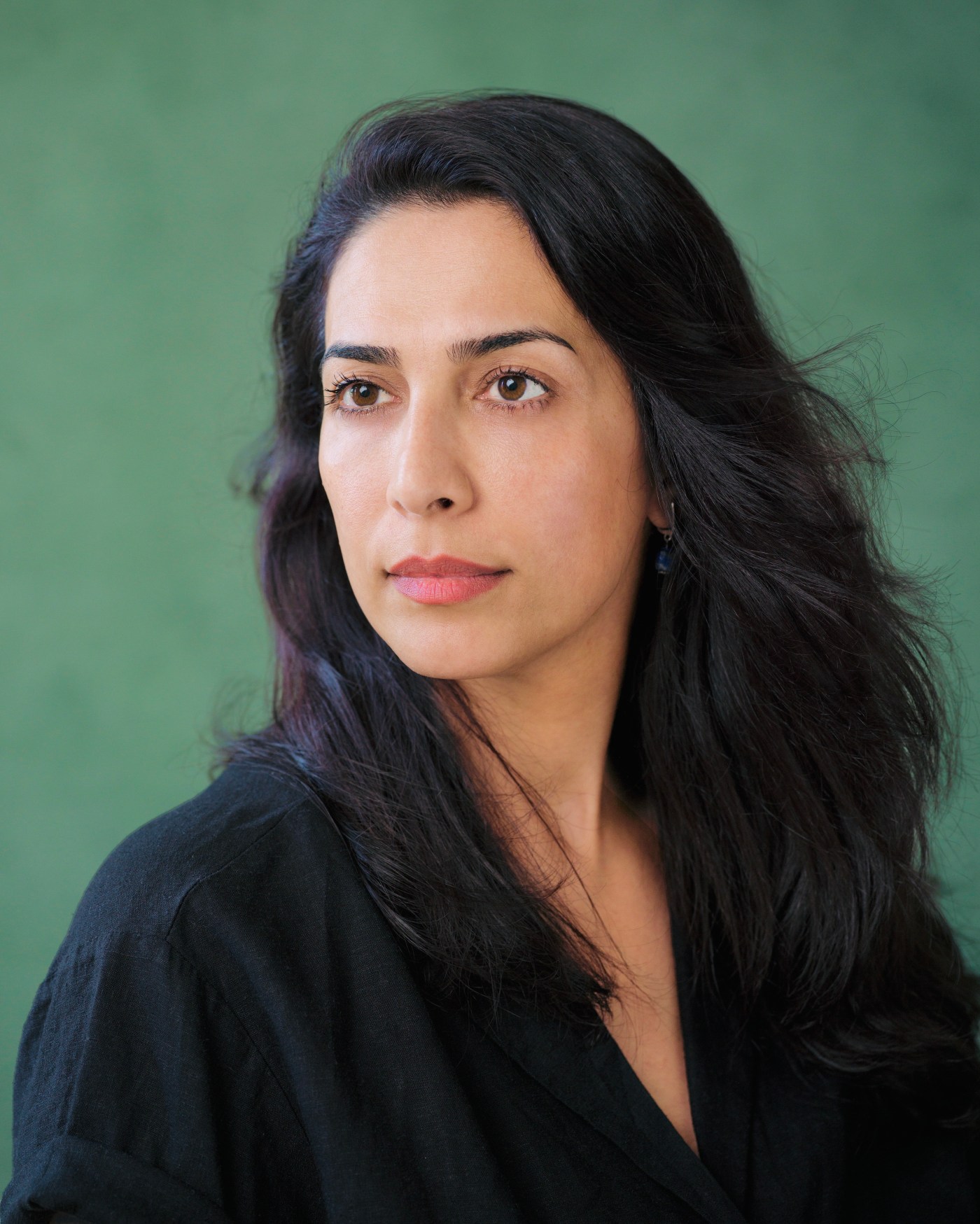
Photo credit: Hadas&Anya Itzkovitch&van Lit
Somaia Ramish is a poet, writer, and human rights advocate, known for her efforts to promote freedom of expression. She founded Baamdaad – House of Poetry in Exile, which fights against the censorship of poetry in Afghanistan, where it has been banned by the Taliban. Somaia Ramish is a PhD candidate in Persian Language and Literature and she gives lectures on women’s poetry in Afghanistan, protest poetry, and creative writing in collaboration with universities around the world, and she is an inspiring speaker. Her poetry, published in multiple languages including English, French, Dutch, Italian, Japanese, Russian, Urdu, and Nepali, has earned her international recognition. Ramish has received numerous literary awards and participated in prestigious global poetry festivals, becoming a significant voice in contemporary literature. She continues to advocate for freedom and against censorship to give voice to the silenced.
NWCC give thanks to Somaia Ramish for these poems!

 KLIMAAKSJON / NORWEGIAN WRITERS´ CLIMATE CAMPAIGN // NWCC