

There is a time for everything. The webpage of the Norwegian Writers’ Climate Campaign was founded to inspire writers and thinkers of all sorts to devote attention to nature’s upheavals, and to provide both the youth and the elderly with knowledge about the nature-historical state of exception. We are sorry to announce that we have to close the webpage; however, the contents will remain available.
From the beginning, we have been systematically committed to a social approach to the whole climate and nature complex. The unbearable fate of migrants and civil disobedience are examples of topics we have been continuously devoting attention to. Insistence on the dissemination of knowledge, language criticism and language awareness belong to the same social dimension, including when elaborated through poetry and factual-poetic ways of thinking. Thanks to collaborations with media such as Klassekampen and Harvest, we have reached out to a bigger share of the general public. A number of actions in the public space got triggered by our ardor in spreading the word. Fritt Ord, our most faithful funder.
As we set out on this actionistic odyssey – to use a fashionable word –, overheating, in the topic’s many variations, was a lead. Today, we must increasingly deal with scenarios such as a possible collapse of the AMOC (‘the Gulf Stream’), and thus possible fimbulwinters1 in the North, in the Arctic; at the same time, there is a trend toward massive melting in the South, in the Antarctic. With regard to natural history, it is in fact a polarised reality. We might also find ourselves in the place with the starkest contradictions in the history of literature, Dante’s Inferno. There, heat and fire reign in the upper circles, while cold has taken power in the lowest circle, Cocytus; a frozen lake for traitors, originally a river which became ice in Dante’s reuse of Greek mythology. Even the devil is stuck in the ice and dully waves forth the coldest wind with his frozen wings.
As we set out on this actionistic odyssey – to use a fashionable word –, overheating, in the topic’s many variations, was a lead.
Let us shortly visit the historical epoch before the heat and cold were to establish definitive opposite poles:
CLIMATE-CRITICAL
Not long ago, the dismissal of everything that got labeled as experiment or trial, artistically speaking, led to obedient, productive, and sealable art forms. Art’s shaky aristocracy soon got a goal-directed meritocracy as its heir, and professional critics were sacked in a number of countries. In their innovative blindness, technologists became occupied with their own AI medium, a medium which in all likelihood is about to undermine democracies, literature, and freedom of speech. This happened long before the old cultural institutions took note of it, and when it happened, the takeover of power was already a fact.
The criticism-allergic conventionalism which has become prevalent within all domains of society leads to a narrowing of public debate. Only matters and ways of writing which are culturally acceptable and “topical” get prioritized in traditional media, something which affects the unpopular climate issue. It is in this vacuum “social media” take over the diversity of expressions, which hence become privatised and individualized.
Is the environmental movement struggling to gain traction, partly because the status of criticism has been devalued? Do politicians and the commentariat continue to fumble, anxious about alarming the public with plain talk about climate catastrophes? What happens to the climate of public discourse when traditional media outlets shed professional critics in favor of «influencers»?
Ever since the concept of «cognitive dissonance» gained acceptance in public discourse just over a decade ago, attempts to explain people’s sedative numbness have themselves become a way of rationalising that very state. This collective stupor seems to be tailor-made for authoritarian forces — for example AI — that quickly will capitalize on whatever happens to be a matter of social indifference at any given moment.
Ultimately, the damaged climate of public discourse legitimises that climate activists around the world either get deemed as terrorists or are met with juridical, economic and legal sanctions. According to Global Witness, almost 2000 environmental activists were murdered globally within ten years (2012-2022). The silence of the media is striking.
Ever since the concept of «cognitive dissonance» gained acceptance in public discourse just over a decade ago, attempts to explain people’s sedative numbness have themselves become a way of rationalising that very state.
In Norway, the State and legal apparatus take vengeance by imposing sky-high fines on young, idealistic activists — who want to save us from certain distress and death. At present, the government is letting itself be inspired by trumpian anti-politics and tries by all means to bypass the Supreme Court ruling about the dumping of mining waste in the Førdefjord. In Great-Britain, terror laws have become the method for undermining the democratic and civil resistance which to an ever increasing extent identifies with the genocide in Palestine. In a peculiar historical trauma, German authorities criminalize engagement for Palestine itself with hair-raising violence and the arrest of protesters.
Does anyone sense the stench from the beginning of the previous century?
Let us praise the ones who put their life at stake and fight for our, everyone’s dignity. Let us protect researchers, artists, authors, journalists and the few politicians who choose to stand in the first row where neither popularity, honour or any other form of reward are visible in the horizon. Let us become aware of the changing force and the silent resistance which is brewing among many people as the signs of collapse no longer can be denied. Sooner or later the social creative force will break loose and change the world from below.
So far, it looks like we are living in an endless 1984. It is in this context the Norwegian Writer’s Climate Campaign has, without any modesty, established an enduring trial of the capacities of language and of literary forms, in order to become a tool for the ones who will perform on bigger scenes than ours. We have let authors who write in around thirty languages unfold about the monumental nature-historical change, in encounters with knowledge about nature and climate in biology, philosophy, economics, marine research and several more domains of knowledge. Every month, the webpage has visitors from 30-40 countries from around the world, and from three times as many in the course of the year. Engaged readers have long since adopted digital translation tools, and thus have access to our content in almost all languages. Our collective text library is being read continuously. We have sought to reach out to the engaged reader in order to strengthen community, knowledge and insight wherever people share their readings with one another.
Even lack of funding and bureaucratic unwillingness could be ignored for a long time with a pinch of idealism, but the reluctance over several years from the Norwegian government agency Kulturdirektoratet was not possible to get around.
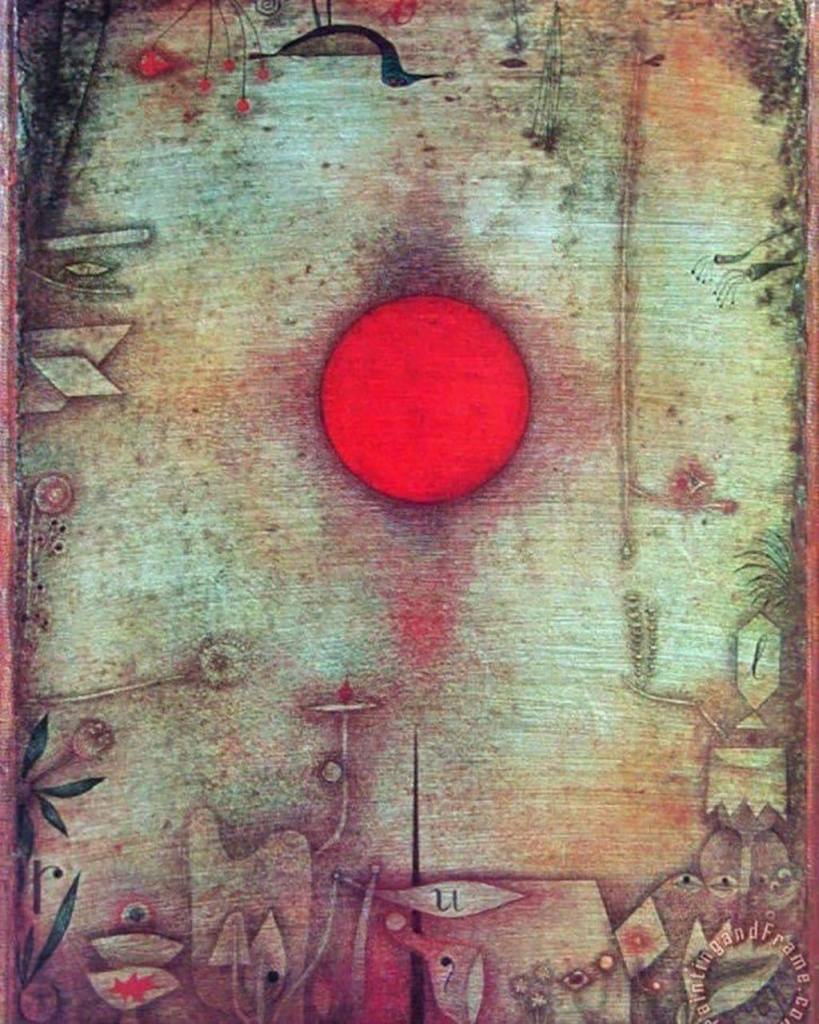
Paul Klee: Ad marginem. 1930. Kunstmuseum Basel.
FATALISM – AND FASCISM
Yes, it is said that knowledge about nature and climate is more unpopular than ever, although the future, naked life, is flooded by oceans and rivers, buried by landslides, burnt off by climate fires and mutilated by evil warlords. Climate researcher Michael E. Mann, who earlier got interviewed on this webpage, puts it in this way in a post on X: “What’s the use of having developed a science well enough to make predictions if, in the end, all we’re willing to do is stand around and wait for them to come true?». I register increasingly often that the kind of blind faith in fate which last century precipitated Europe into fascism’s perfidious violence, once more is asserting itself on our continent, while climatic meltdown is happening in front of our very eyes.
Slogan politicians know how to get the masses drunk with well adapted lies and half-truths and often get an easy game among people who are worried for their safety, their work and their survival. The great Italian writer Alberto Moravia went thoroughly into this pre-political landscape in the novel The Fascist, which was published in 1951. There we follow a fascist seedling all the way from childhood’s sadistic penchants towards animals, plants and fellow humans, with personality features being described as melancholy, dead feelings and an instrumental relationship to everything alive. Moravia’s stroke of genius is that he lets this instinctive person, Marcello, long for normality as a hide for his abnormal tendencies. The longing for belonging to normality’s “everybody” drives this figure into the claws of the Mussolini regime and the mental dope of mass movement. There, Marcello finds a kind of false mental rest, confirmed by a mass suggestion which in spite of his own emotional coldness creates the vague obsession of getting to merge into a bigger apolitical unity, an abstract, fateful utopia. Immaturity and mental confusion are the personal qualities in this Italian fascist, which in spite of maniac trials of self-reflection, don’t know his own inner manipulability and hence cynically manipulate everybody around him.
In our time, human immaturity and confusion are again the prelude to nihilistic tendencies, and at the same time as populism one more time adopts obscure fascist signs of recognition and the world is burning, fatalism is hitting people and authorities like a violent heatwave. Is it collective self-pity which is gaining ground? According to a currently living Italian author, Antonio Scurati, this time isn’t a return to fascism as a political system, but to the figure of Mussolini, whom many have called “the first populist”. Mussolini registered that people in crisis are in need of “primary colours”, as well as striking political answers, Scurati claims2. In the fury of the crisis, people don’t listen to factual reasonings; they want aggressive fear rather than peaceful hope to be confirmed, and preferably a common enemy.
In our time, human immaturity and confusion are again the prelude to nihilistic tendencies, and at the same time as populism one more time adopts obscure fascist signs of recognition and the world is burning, fatalism is hitting people and authorities like a violent heatwave.
Do polite, well-meaning politicians understand what we are up to? Do we, who belong to the environmental movement and the peace movement, understand that engagement needs to have richly coloured cultural expressions, catchy formulations and new civil-political alliances? Where are the initiatives and the effort from the choir of cultural institutions, theatres, orchestras and cultural personalities with wide public appeal when climate actions take place?
“RESISTANCE AND SURRENDERING«3
The sooner we realize that our very humanity is under attack, and that such attacks begin with military and technological abuse of power which invade our nature sensitivity — our naturinngivelser, the sooner we are going to discover that resistance and community are the only hope of humanity. Nature sensitivity, understood as in-breathing receptivity, or “naturinngivelse” in Norwegian, is an old concept which barely is in use anymore, and an idea which has become foreign. It expresses the gift friendly fellow humans get to experience, i.e. the breathing in of the inspiration which our surroundings, be they cultural, natural or spiritual, can grant us, if we are receptive. Read the interview with Robin Wall Kimmerer about gift economy and mutual dependency. May love never become a taboo word in the literary and political use of language!
Nature sensitivity, understood as in-breathing receptivity, or “naturinngivelse” in Norwegian, is an old concept which barely is in use anymore, and an idea which has become foreign.
It has to be said clearly. The fight for dignity will demand more of people all around the world than we can comprehend today, but at the same we know that colossal enemies have been overcome through for instance the fight against fascism during World War II. There too, activists and resistants stood alone at first, before it became evident for people that common efforts of all kinds were inevitable.
Climate activists are ahead of their time. These courageous, loving young people understand that it still is the oppressed in this world who are forced to bear “the white man’s burden”, and that the genocide in Palestine to the highest degree has to do with the worldwide crime against humanity: oil companies’ deadly and conscious exploitation of nature through decades, sanctioned by democracies.
NATURE, RENEWAL
It goes too slowly, but news about good changes and rewilding also can be read almost every day. Overgrown rivers are being opened, fish, birds and other endangered species go back to freed natural spaces; oceans, water bodies and other nature forms obtain juridical rights; various countries, such as Spain and Pakistan, triumph with solar cell energy, just to name a few light points in our time’s “darkness at noon”.
It’s easy for us to forget that signs of hope sprout where we live our lives amongst fellow humans. XR activist Jonas Kittelsen writes in the anthology “Vår tid er nå” (“Our time is now”) about dialogue as a golden opportunity when meeting skeptical students, a way of thinking he deepens in his first book, Verden venter på oss (“The world is waiting for us”). In spite of suffering and misery, human beings will belong to this big dynamis, the life force which unites everything alive: When we finally realize that we are about to loose this precious natural fellow life to stupidity and evil, it is our duty to hope for a fighting majority to save each other-and-life in all their irreplaceable greatness. And let us not forget for a moment the words of Dietrich Bonhoeffer: Stupidity is a more dangerous enemy of good than evil.
The Norwegian Writers’ Climate Campaign has, in its social and linguistic resistance fight drawn upon a highly competent editorial board with leading authors and philosophers from a number of countries, who in different ways made this webpage possible. Many thanks for solidarity and outstanding contributions to the work, and especially to those who during shorter periods of time contributed as editorial secretaries. No one mentioned, no one forgotten.
To see this outstanding collection of texts emerge, in all thinkable genres, and with many forms of knowledge and insights, and to get to participate in the reading and editing of all these many hundreds of linguistic and artistic becomings, surpasses by far what I imagined from the beginning. The motivation is and will always be that it is gratifying to share, be it time and money, struggle and joy, and that mutual persuasion creates a durable and colourful community of disagreement.
First and foremost, let’s listen to Jorie Graham’s urgent appeal in her new and shaking book Killing Spree, the most farsighted among the world´s poets, here from the poem “Demonstration”:
…
If you can hear me there,
if this reaches you,
forgive us,
we did not know who we were.
We thank heartily our readers in many countries for the company and will always keep eyes open for possible reencounters.
Fredrikstad, 13.VIII.26
Freddy Fjellheim
Editor-in-Chief and Publisher
Grafikk: Josefine Gjerde.
// Naïd Mubalegh (born 1989) has an academic training in evolutionary biology, ecology and philosophy and history of science, as well as a long experience with translation. Growing up in the Loire valley in France to a father from Afghanistan and a mother from Brittany, she became a birdwatcher in her childhood. After moving to Oslo in 2019, she became engaged locally in BirdLife Norway’s activities. She is currently a visiting researcher at the University of Oslo, while finishing a doctoral project in philosophy of science at Sorbonne University. Her research focuses on the influence of economic theories on evolutionary biology, and vice versa. She also works as a translator and a writer, among others with a regular column in the Norwegian weekly newspapers Dag og Tid, combining a literary and journalistic approach to birds.
/// Members of the Editorial board, NWCC 2013-2026:
Sofie Isager Ahl, Eva Bakkeslett, Sissel Bergfjord, Oleh Bohun, Inga Bostad, Daniel Boysen, Nickole Brown, James Byrne, Susanne Christensen, Ragnhild Freng Dale, Anders Dunker, Elisabeth Eide, Thomas Hylland Eriksen (1962-2024), Martin Fjeld, Freddy Fjellheim, Forrest Gander, Josefine Gjerde, Jonas Gren, Kathleen Rani Hagen, Johannes Heldén, Anne Karin Jortveit, Silja Henderson, Sigurd Hverven, Ishion Hutchinson, Søren Toft Høyner, Carsten Jensen, Aaron Kent, Michael Marder, Marius Mikkel Kjølstad, Eirik Høyer Leivestad, Agnar Lirhus, Alice Miller, Mette Moestrup, Naïd Mubalegh, Sidsel Mørck, Randi Nygård, Tommy Olsson, Lars Haga Raavand, Sofia Roberg, Ariel Rosé, Line Madsen Simenstad, Lars Skinnebach, Kim Simonsen, Ingrid Storholmen, Mats O. Svensson, Mats Söderlund, Karolin Tampere, Arne Johan Vetlesen, Randi Ward, Charlotte Weitze, Jesper Weithz, Andreas Ytterstad.
1 In Denmark, Norway, Sweden, and other Nordic countries, the old norse term Fimbulvetr or Fimbulwinter refers to an unusually cold and harsh winter.
2 Nexus Institute. Rundbordkonferanse med Antonio Scurati.
3 The title refers to a book by the theologian and priest Dietrich Bonhoeffer, who was hanged by the Nazis because he participated in a conspiracy to kill «der Führer.» May Bonhoeffer’s memory be honored in these times.


