
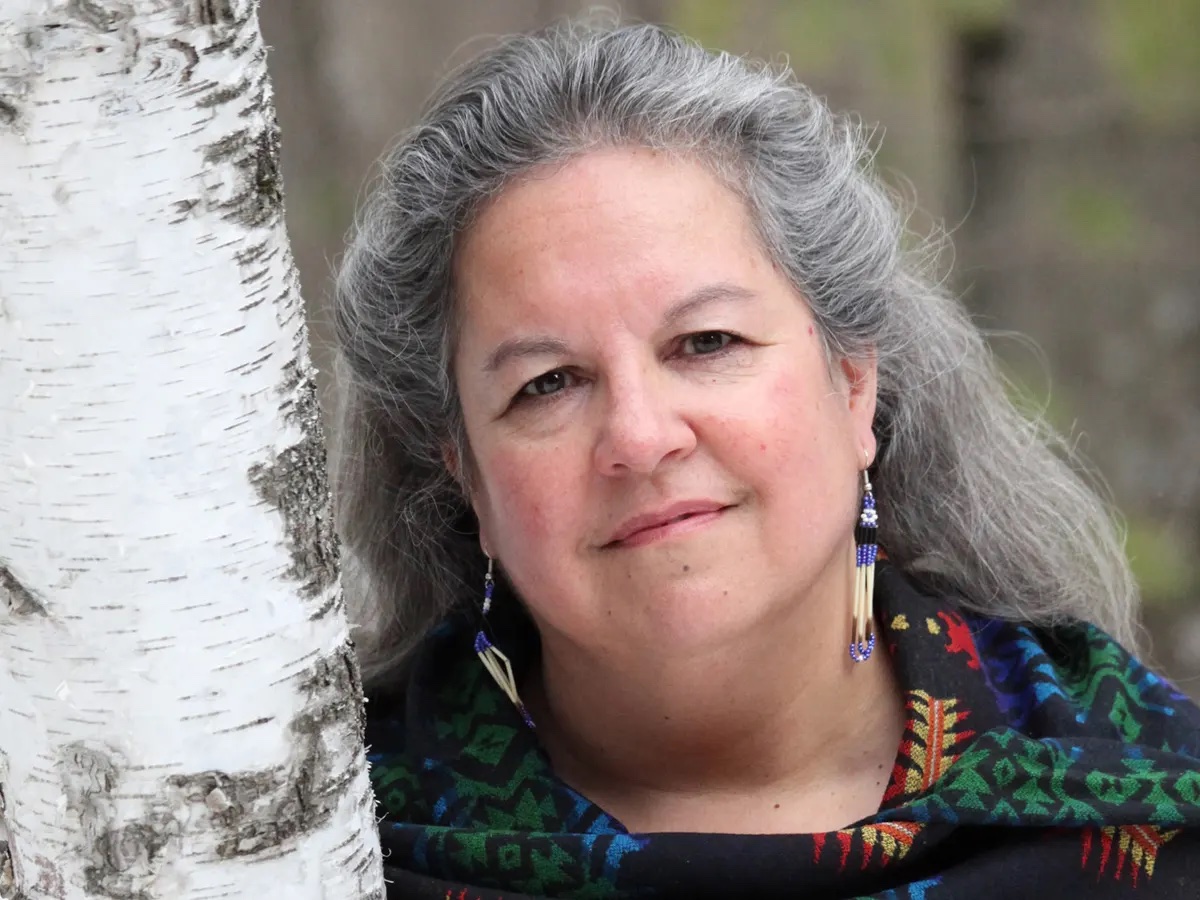
Biologist, author, and activist Robin Wall Kimmerer is above all known for the landmark book Braiding Sweetgrass, which, a decade after its publication, continues to find new readers. In environmental discourse, Kimmerer’s books and essays have helped bridge the gap between scientific discourse and Indigenous perspectives. In Kimmerer’s writing, the attempt to overcome this broken tradition forms part of a larger undertaking: to reclaim a lost way of living, feeling, and thinking that offers an alternative to the hegemonic culture of the West. As a proponent of agroecology, with one foot in the biological and ecological sciences and the other in suppressed regenerative knowledge traditions, Kimmerer offers an alternative perspective that challenges capitalism — the gift economy.
AD: I want to begin with the Indian activist and agroecologist Vandana Shiva, who I heard her speak in Santa Barbara some years ago. She ended her talk with these words: “Together we can regenerate a paradise on Earth.”
The idea of imagining paradise ahead of us, gleaming somewhere in the distance is, of course, paradoxical – especially for Westerners. In our most central myth of origin, Adam and Eve were chased out of the garden of Eden. If the expulsion from Eden once was a myth, it now feels confirmed by history through our environmental destruction. It seems clear that our view of nature – which is every bit as mythical as it is scientific – shapes our understanding of value and meaning. How can an alternative mythical vision, like the one you retell in the beginning of Braiding Sweetgrass speak to us today, in the age of environmental calamities?
RWK: The Skywoman creation story – certain facets of it – is shared by many peoples of the Great Lakes and the Northeast, but the general outlines are that life was all in the sky world, and people lived there with lives very much like we have today.
In the sky world, there was a remarkable tree called the Tree of Life, or some call it the Tree of Light. On that tree grew every kind of plant, all plants growing from this one tree. One day a big windstorm came and toppled that tree, which opened a hole in the ground. When Skywoman went over to peer into it and ask, “What’s going on here?” she saw that it was not an ordinary hole in the ground but a portal – just darkness below. As she leaned over to look down into this great emptiness, she fell, or depending on the version, she was hurled – or in my version of the story, she jumped.
She’s falling into uncertainty, into darkness, far from everything she knows. Importantly, in that story, what seemed to be emptiness and darkness all around her was in fact the void above the water world. All the beings in the water world saw a shaft of light coming through the darkness, and they saw just this little speck. They flew up and realized it was a woman. They caught her. The geese caught her on their wings. They brought her down to the water and said, wow, we have a newcomer here. She needs land. She can’t live here. And then – it’s a long story – the turtle said, let her rest on my back while we figure out what to do.
The first interaction between humans and the more-than-human world was rescue. The others were already here. They were equipped to save us, and they did.
The first interaction between humans and the more-than-human world was rescue. The others were already here. They were equipped to save us, and they did.
AD: You describe how, in many Native American traditions, humans are understood as newcomers to the earth. We have to learn from those who arrived before us and know this world better. I find this extraordinary, not least because it’s true to evolution, since we humans belong to such a young species.
RWK: And it’s true also of the apparently new science of biomimicry, which is all about learning from and imitating nature.
The long story continues: one by one, the animals – who had their own creation stories, who had heard there was mud at the bottom of all this water – tried to dive down and get some so they could make land for her. One by one they failed, until only the most humble of the relatives was left: the little muskrat. He dove down deep to get that mud. But when the body of the muskrat floated up – because he gave his life, he died in the attempt to get soil for her – there, in his little hand was a pellet of soil.
Skywoman then took that soil, the sacrifice of the animals in caretaking for people, and spread it over the back of the turtle. Then she began to dance and sing and practice gratitude. And through this expression of gratitude the turtle grew and grew and grew to become what we call today, Turtle Island, or North America.
It’s the alchemy of human gratitude together with the gifts of the other living beings that created home – which is such a powerful idea!
Mythic repetitions
AD: Significantly Skywoman herself is also playing an active part in creating the earthly garden, rich with treasures.
RWK: Yes, because Skywoman did not come empty-handed: she had broken off a branch of the Tree of Life when she fell. She had with her the seeds and the fruits of every plant. She then spread them on this newly created earth so that all beings could be cared for.
It’s a story of the past, but I think it’s very poignantly a story of the future as well and how do we jump and then create the new future that we all want to live in?
AD: Within climate scholarship and cultural thinking around environmentalism, there has been much discussion of the injunction that God gave man dominion over all nature. Whereas the deepest message of Christianity is arguably love and gratitude, it could seem that Western culture has instead compulsively repeated the transgression and the fall. How can we get out of this tragic misinterpretation of our own destiny?
RWK: To me, the story of Skywoman provides the counter-narrative to the doctrine of dominion over nature. It clearly lays out human responsibilities toward the other organisms who were here first, and those responsibilities are gratitude and the giving of our own gifts in return. It’s a vision of the commons, not of private property – a vision of mutual responsibility and accountability to one another.
There are several versions of the Skywoman story. In the one that is most well-known, the one I tell, she was passive – she fell to the new world to create the world that was to come. In other versions she was pushed, because it’s hard to leave home, hard to leave the comfortable for the unknown – it takes so much courage.
But the narrative I’ve been playing with, knowing Native women, is this: What if she jumped? I’ve been thinking a great deal about what conditions would lead one to jump to a new world – because that is what we’re being asked to do: to leave behind a story and an ecological situation that doesn’t serve life and choose something else.
AD: To what extent can the care for others, for one’s own children bridge the gap between individualism and care for others, for the future?
RWK: Skywoman was pregnant. She was already thinking about the future of people. So, she might have jumped because something fearful was bearing down on her – and in the climate crisis we can feel exactly that way, caught in a tsunami of devastation that would make anyone leap just out of fear, hoping to land somewhere better.
But I like to think that what she saw and heard was something so beautiful that it was where she wanted to raise her child. And that aligns deeply with the metaphor you created in the beginning, of a future paradise that gleams in the distance. What are the conditions under which we choose to jump away from capitalism, from an extractive economy, from the path of mutual assured destruction we’re on? What would it take for humanity to say: I want to switch lanes – change paths – from this destructive narrative to a regenerative one?
I’ve been thinking a great deal about what conditions would lead one to jump to a new world – because that is what we’re being asked to do.
AD: Coming from our capitalist culture, how can mythology help us imagine a sustainable world today?
RWK: I think you need some sense that there’s a landing place, that someone will catch you. In Skywoman’s world, that’s the embrace of more-than-human kin: relatives who will take care of you, as the turtle and the water beings took care of her.
I think that’s part of the enticement to jump out of the destructive story we’re in – we need to know we’ll be taken care of in the new place.
And it would help to have someone’s hand to hold when you jump, so you’re not alone. The recreation of community helps you know that you’re not jumping alone. And that’s something really missing from our current narrative: in a capitalist world so focused on hyper-individuality, we don’t have a hand to hold.
The lost lessons of the new world
AD: Going back to the origins of capitalism, it’s telling that when Enlightenment philosopher John Locke writes about property, he cites the New World and Native Americans as his example. He complains that the wilderness is unproductive – today some would call it underexploited. It may seem he drew the wrong lesson in his reflections on the Native Americans?
RWK: We’re talking about imposed colonial capitalism in exactly the setting you’re describing. Locke’s notions were deeply tied up in the Western worldview and the notion of human exceptionalism. The land was therefore understood as something that must be exploited and extracted – because the land is essentially an object.
What colonists failed to perceive in their misreading of indigenous land management in the Americas is that stewardship – tending a great forest and prairie garden – didn’t look at all like the monocultural, disruptive extractivism of Europe – so they didn’t recognize it as management. But the science is unequivocal: Native peoples were sophisticated land managers. The reason there was such abundance is that they used cultural tools that mimic natural disturbance to generate it. The myth of the pristine – that the land was unused and unmanaged – is simply false.
The idea that there was nobody here – terra nullius – tied up with the doctrine of discovery and rights to land, gave a kind of tacit permission for violent subjugation of Native peoples and of the landscape. Here kinship is the crucial factor, the notion that all flourishing is mutual, that the maples and the beaver and the elk and the lily pads all have as much claim to the wellbeing of the earth as our species does. That idea is utterly foreign to the Western colonial mind, steeped as it is not only in capitalism, which used Christianity to reinforce that same pyramid. Worldviews in conflict – and the power differential between those worldviews and the peoples who held them – led to the colonial devastation whose echoes we still live with today.
AD: To what extent did the methods and language of science play a part in what you call the objectification of the landscape?
RWK: It’s no coincidence that English is the language of global capitalism, because in English we refer only to members of our own species with a grammar of respect. We say “him”, or “her”, or “you”. But every other organism on the planet we refer to as “it”. Encoded in the language is the objectification of nature and the superiority of humans.
Whereas in Indigenous ways of knowing and speaking, it’s impossible to say “it” about another living being. We refer to other living beings with the same grammar we use for our human families, because they are our families. This is the essence of the kinship worldview: we are all persons.
What colonists failed to perceive in their misreading of indigenous land management in the Americas is that stewardship – tending a great forest and prairie garden – didn’t look at all like the monocultural, disruptive extractivism of Europe – so they didn’t recognize it as management.
AD: If you were to translate a sentence into English, how would it sound when you’re talking about the beaver, the flowers, the mushrooms?
RWK: It’s very difficult, because the language isn’t constructed around pronouns – it’s constructed around verbs. There are animate verbs and inanimate verbs. There’s a different verb for hearing a sparrow sing than for hearing a plane go over. The animacy of whoever you’re talking about is conveyed in the verb, not in a pronoun. And of course it doesn’t translate directly into English grammatical structures. The closest I can get would be: if we’re talking about a pine tree, we would say that pine tree who stands on the shore, not the pine tree that stands on. Other beings, other species, are understood as someone’s, not somethings.
And from that fundamental recognition of the personhood of every single being arise very different ethics. One that says: it’s all stuff, so I should exploit it for my own species and my own individual good. Or: these are all my relatives, with whom I am in reciprocity, for whom I have gratitude, whose gifts are keeping me alive in this moment. Obviously we can’t photosynthesize, so human beings have to take from the earth. But if you take from the earth thinking it’s all your property, all object, you do so without ethical restraint, because it’s yours and it’s just – your resource.
A self beyond individualism
AD: One important lesson from your books is that when you get a gift, you don’t say, «Oh, I get this for free.» That would be a deep misunderstanding of the gift!
RWK: Exactly. When something is free, you say: well, I’m going to take as much as I can – there’s plenty here. When it’s a gift, there are restraints on your consumption, because you don’t want to take too much from your beloved relative. That would create a tremendous and unethical imbalance. All these things we’re talking about are connected – back to this fundamental question of human exceptionalism versus kinship with the living world.
AD: In The Wealth of Nations, Adam Smith says he doesn’t trust that the baker will bake enough bread for everyone out of the goodness of his heart. He trusts the baker to do it because of his self-interest.
RWK: Oh, I’m so sorry that he had to experience that! In gift economies – as in any economy – we want security. Let’s take food security. You could achieve it through the colonial capitalist agenda: grow more than you need, hoard the surplus, create scarcity, get money, and that’s where your security comes from. We’ve demonstrated that this works to create a certain kind of security, though it fails in other ways.
But couldn’t you also achieve food security through a web of good relations? Instead of hoarding surplus, you invite your neighbors to share the feast. You’re not storing it, not privatizing it, you’re sharing it with everyone and creating reciprocal relationships. This contrast doesn’t deny the need for security – that’s what these systems of exchange are for.
Both work – but by very different ways of being. One has the currency of gratitude, reciprocity, respect, relationship. The other has the limited currency of money.
AD: Even in our modern, capitalist societies, still know very well how a gift works. How can this knowledge help us transcend the logic of buying and selling, of self-interested exchange?
RWK: Humans tend to be so shortsighted that we think capitalism is our default option – but capitalism is extraordinarily new compared to the long equity of gift economies. Long before capitalism, there were systems that distributed goods and services equitably for the wellbeing of communities, without a market economy.
When we think about self-interest in an evolutionary sense – yes, we maximize self-interest – but I think it brings us back to the question of the permeability of the self. What is the self? In capitalism, the self is the individual embodied self. But what if we take a more expansive view? Is it me who’s talking to you right now, or is it the billions of gut bacteria in me? Is it my invertebrates? Is it the corn I ate for breakfast? Is it the bird that made me so happy this morning that I had the energy to talk to you?
Humans tend to be so shortsighted that we think capitalism is our default option – but capitalism is extraordinarily new compared to the long equity of gift economies.
The bonds of survival
AD: This collective view brings us back to biomimicry, and the practice of learning from nature. In your book, The Serviceberry, you describe trees tend to put fruit all at the same time precisely to overwhelm the nut-eaters, so that so many nuts get buried and forgotten, seeding new trees. The more general lesson is that abundance, wealth, is meant to spread so that it benefits many parties, many actors and species. Abundance comes first; scarcity, you say, is created. But, of course, nature also knows hard times – a difficult year, a frost or a draught. So what do we do when scarcity strikes? How do we prepare for it as a community?
RWK: By sharing, by sharing knowledge, by sharing what little you have, the ancient cultures of hospitality arose just from that of saying, “Whatever I have, I will share with you”. It’s this notion of mutual flourishing that there’s not going to be some folks in your community who are getting fat while everybody else starves. It’s not going to happen. It’s just not how a gift economy works in times of scarcity. Does it open up the possibilities of failure and mortality, et cetera, for your family? It sure does. That’s how nature works.
AD: There are two visions of a collective in crisis. One is that everyone fends for themselves, fights the others off, hoards and hides – the whole survivalist, individualist agenda. The other is people come together, share what little they have, and help each other. How can we affirm the need for a gift economy, while acknowledging that both these two sides of human nature – competitiveness and mutualism – are real?
RWK: Both tendencies exist in nature for sure, but we have grossly overlooked the importance of cooperation – particularly given your notion of this wasteland we seem to find ourselves in, this time of scarcity we have to cross before we can find our earthly paradise.
I’m certainly not an expert in the science here, but as a biologist, I keep thinking about the lichen symbiosis, in which an alga and a fungus cooperate so thoroughly they essentially become a single community, become one organism. In the lab, researchers have tried to recreate this, and what they found is that lichenization happens with much greater readiness when they have to endure a time of great scarcity. A stressful habitat, not abundance, triggers the partnership. I think there’s an important teaching there: in times of scarcity mutual aid is precisely what we need.
There are two visions of a collective in crisis. One is that everyone fends for themselves, fights the others off, hoards and hides – the whole survivalist, individualist agenda. The other is people come together, share what little they have, and help each other.
AD: Mutual aid also involves obligations – not just toward humans in reciprocal self-interest, but also toward nature which sustains us. And we moderns seem to have a problem with that.
RWK: It’s so striking to me that obligation is seen in a negative light, because to me, reciprocity is a joyful practice. The opportunity to be in right relationship with other beings cultivates and upholds that inherent sense of justice we have as human beings. I have a kindergartner in my life, for example – and children from a very early age have a profound sense of justice.
AD: Oh yes. It’s not fair!
RWK: It’s not fair. And I happen to think that when things are fair, we’re happier. We feel secure. That sense of ease that comes with fairness – knowing we’re going to be treated well, that if there’s not enough to go around, we’ll all be hungry together – creates connection, relationship, and from that a sense of belonging.
I’m trying to understand why being in reciprocity feels joyful to me – and I think that’s why. It creates fairness, which creates security, which creates the knowledge that we’re all in this together.
Appreciation is the origin of value
AD: What’s also fascinating about the gift economy is that receiving a gift feels good – but so does giving one. The same could very well be said about gratitude, because it has a strange – almost mysterious logic: the more you appreciate something, the more it’s worth to you. You can go on appreciating and the value just keeps growing – as if you’re generating value out of nothing!
RWK: Well said. And to me, this cycle begins with attention. Attention leads to a sense of gift. A sense of gift leads to gratitude, which has the motive force that you have just described. And then out of gratitude, we want to give a gift back because we’re so moved by the generosity, the beauty, the justice or whatever that motive force is. And then as we give back to the living world, the living world becomes more abundant . There is a whole cycle that runs from attention to gift to gratitude to reciprocity, and swept up in that circle is awe, is joy, is reverence, all those things that make life worth living. I don’t think we can say that about money.
AD: It is striking how capitalism and modern consumerism are intensely secular and non-ritualistic. Is the problem that we are alienated from the products we purchase, made far away, by people or machines we will never see?
RWK: I think it comes down to changing our minds, changing our narrative towards a sense of who it is we’re consuming. To be able to understand that the world is not an Amazon warehouse. Whether we’re buying that paper at a discount store or not, it still came from a tree. And if we return to that model of the personhood of all beings, if we truly internalize it, then what we’re consuming are not merely things – they are objects, yes, but they are also the manifestations of the life force of other beings. There is a sense of respect and reverence. And that carries elements, depending on your frame of the world, that are not strictly secular. It says there’s something larger than me. It doesn’t necessarily ascribe that to a divinity or a deity. It simply says: these are lives, and I have respect for life. I have reverence for the beingness of what I am consuming.
There is a whole cycle that runs from attention to gift to gratitude to reciprocity, and swept up in that circle is awe, is joy, is reverence, all those things that make life worth living. I don’t think we can say that about money.
AD: Which in your vision extends beyond living organisms, even to the elements, to winds and water, that cross all boundaries. You have suggested that we shouldn’t buy bottled water, because water should belong to everyone, and not be profited from?
RWK: This, too, comes back to reverence – reverence for the commons. The privatization of the commons – water, in particular – is deeply troubling to me. It feels like an ethical affront. Water is a gift to the commons. None of us make it rain. This is not our doing. It is the outcome of biogeochemistry. So how could we ever presume to own it? It offends my sense of reverence to say: I own this. And you can carry it further – what does it mean to own land?
Nobel-prize winner Elinor Ostrom’s beautiful economic work about community-based preservation of commons has shown that the idea of ownership is not inevitable – as does millennia of people operating within gift economies.
But it’s also important to note that gift economies don’t work if there are lots of cheaters. A gift economy functions because it’s based on reciprocity and relationship in small communities where you know one another, where you’re accountable to each other, where honoring your reputation matters.
Ecological karma
AD: You also draw a distinction between taking from nature in a way that can rightly be seen as receiving a gift, and stealing or plundering. How do indigenous cultures sanction and restrain ingratitude? How is it held in check socially?
RWK: We have many stories where people were ungrateful, where they took too much. There are also stories with ethical outcomes: a hunter who took too much will no longer have luck in the hunt. And often the mechanism is that they have offended their relatives – and so their relatives will no longer offer themselves.
AD: In this sense, plunderers and squanderers are punished by nature itself. It’s like karma, perhaps?
RWK: Exactly. It’s karma ethically, but it’s also the logic of ecology itself – because if you take too much of something, you deplete the resource, remove too much nutrition from the cycle. That’s simply how it works, which as an indigenous scientist I find deeply satisfying.
AD: How do we move from “the global standard farm” – with its fertilizers, pesticides, and monocrops, one blanket solution applied everywhere – to something genuinely attentive to local nature, local soil, local species?
RWK: That’s what sustainable agroecology looks like. You don’t deplete the soil by taking too much. You create agroecosystems that enable pollinators to flourish through complexity, through a circular economy rather than a linear export. In a sense, contemporary monocrop agriculture is simply mining soil – very little replenishment, the soil being mined, depleted, poisoned, its structure ruined. When reciprocity is absent, there is a trajectory toward depletion. When reciprocity is present, there is the potential for regeneration.
Old growth – and life as wealth
AD: The French sociologist Marcel Mauss saw gift-giving in modern society as a residue of an older way of relating to each other and the world. Agroecology also seems to build on such a residue. At the same time it is a modern, forward-thinking movement. How can we make agroecology transformational, something really revolutionary?
RWK: For agroecology, it comes back to biomimicry, learning from and imitating nature. We have to try to understand: how does nature replenish herself, and how do we model that? We need to apply the honorable harvest and reciprocity biophysically and culturally, we need to go back to a time where we’re not taking without replenishment.
And I think it is also ethical and spiritual. We call it the honorable harvest because it’s also ethical: it shows respect for those plant beings as persons.
We call it the honorable harvest because it’s also ethical: it shows respect for those plant beings as persons.
AD: You write about monocrops, how they require us to mow down and plow a field, creating artificially cleared ground into which fast-growing “pioneer species” rush in. There’s a parallel with culture and the strategy of colonialism here. But what would an old-growth civilization look like?
RWK: I like to say that we need to be in an age of remembering. What we need to be remembering is precisely old-growth cultures, which are complex and layered. Even in the names we give them – old-growth cultures, cultures of longevity – they are sustained by, and they sustain so much more life than the early successional monoculture: that highly productive, efficient way of being that cannot endure.
To me, what we really need to be reaching for is an ethic of success that isn’t about being the biggest and the fastest and the most productive, but the most enduring. We could take a lesson that what it means to be successful is to endure with beauty and diversity and maximizing life. To me, that’s what wealth is. And that’s part of that vision of the world that I want to live in is a world that endures. And by saying it endures, I don’t mean it’s not dynamic or that it’s static in any way, but that old growth cultures and old growth ecosystems really have more life!
/
Robin Wall Kimmerer is a mother, scientist, decorated professor, and enrolled member of the Citizen Potawatomi Nation. She is the author of Braiding Sweetgrass: Indigenous Wisdom, Scientific Knowledge and the Teachings of Plants, which has earned Kimmerer wide acclaim. Her first book, Gathering Moss: A Natural and Cultural History of Mosses, was awarded the John Burroughs Medal for outstanding nature writing, and her other work has appeared in Orion, Whole Terrain, and numerous scientific journals. In 2022, Braiding Sweetgrass was adapted for young adults by Monique Gray Smith. This new edition reinforces how wider ecological understanding stems from listening to the earth’s oldest teachers: the plants around us. Robin’s newest book, The Serviceberry: Abundance and Reciprocity in the Natural World (November 2024), is a bold and inspiring vision for how to orient our lives around gratitude, reciprocity, and community, based on the lessons of the natural world.
Robin tours widely and has been featured on NPR’s On Being with Krista Tippett and in 2015 addressed the general assembly of the United Nations on the topic of “Healing Our Relationship with Nature.” Kimmerer is a SUNY Distinguished Teaching Professor of Environmental Biology, and the founder and director of the Center for Native Peoples and the Environment, whose mission is to create programs which draw on the wisdom of both indigenous and scientific knowledge for our shared goals of sustainability. In 2022 she was named a MacArthur Fellow.
As a writer and a scientist, her interests in restoration include not only restoration of ecological communities, but restoration of our relationships to land. She holds a BS in Botany from SUNY ESF, an MS and PhD in Botany from the University of Wisconsin and is the author of numerous scientific papers on plant ecology, bryophyte ecology, traditional knowledge and restoration ecology. She lives on an old farm in upstate New York, tending gardens both cultivated and wild.
Photo Credit: Dale Kakkak.
//
Restaurering av natur, bevissthet og litteratur.
Vi kan ikke fullt ut forstå et fenomen eller en sammenheng om det ikke speiles i språket vårt. Kan det være slik at klimaendringene og naturnedbyggelse får skje fordi vi både gjennom språket og kulturell selvforståelse lever distansert fra naturen? Forfatternes klimaaksjon vil med prosjektet Restaurering av natur, bevissthet og litteratur invitere til en samtale om hvordan språket vi bruker påvirker vår evne til å se og skape alternativer i naturmiljøenes sammenheng.
Naturfornyelse eller rewilding betyr å la ville dyr, insekter, planter og fugler få tilbake sine habitater slik at naturen kan bli menneskets hjelp til selvhjelp. Inspirert av forfattere som Paul Hawken inviterer vi skrivende folk til å reflektere over livgivelse og rewildening som konkret praksis og tenkemåte, med spesielt henblikk på språkbruk og litteraturens rolle. Ved å sentrere livet, oppmerksomheten og omsorgen til alt rundt oss – medmennesker, fugler, dyr, planter og insekter, hav og bekker, skog og fjell – kan klimasaken nå også dem som ikke lar seg treffe av trusler og fordømming, men instinktivt leter etter gjøremåter som gir resultater og mer løfterike tenkemåter.
Tidligere artikler i serien:
Forrest Gander: Ecological Poetics as Rewilding.
Anders Dunker: Likhetens kraft på ulikhetens slagmark
Marius Timmann Mjaaland: Hyperpolitikkens natur.
Freddy Fjellheim: Vår tids helter
Utgitt med støtte fra Fritt Ord.


