
“A poem, even excavated from its context and the time
of its writing, is a curiously renewable form of energy.”
Proponents of contemporary ecological poetry, sometimes called ecopoetics, often begin from a dissatisfaction with representation. To describe the world as an object “out there,” even with sympathy or care, tends to re-inscribe the very separation that ecological thinking seeks to undo. The challenge, then, isn’t simply to write about ravelment, but to let ravelment take place in the writing itself. Form becomes more than a vessel for content; it becomes an event in which human subjectivity and world co-emerge. Syntax, structure, and the visual field of the page can perform philosophical work, staging relations rather than explaining them.
The first poem of Jorie Graham’s Sea Change, for instance, begins
one day: stronger wind than anyone expected. Stronger than
ever before in the recording
of such. Un-
natural says the news. Also the body says it. Which part of the body— I look
down, can
feel it, yes, don’t know
where. Also submerging us […]
Formally enacting the theme of the collection, Graham’s alternately long and then indented short lines suggest—metaphorically and experientially— a tipping point. As readers and as inhabitants of a stressed ecosystem, we find ourselves running up against the vertiginous edge of an extended critical moment.
At the level of syntax, such poems often mean to loosen the dominance of a sovereign subject. Sentences might wander, accrete, or hinge on conjunctions rather than conclusions; agency drifts between human and nonhuman actors. Parataxis replaces hierarchy, allowing phrases to coexist without being subordinated to a single controlling perspective. Such syntactical openness may be thought not just to mirror ecological systems in which causality is distributed and outcomes are emergent, but to confront the complexity of our exigent situation. A reader is called to engage the re-wilded poem with a different sort of attentiveness—one that may feel less like mastery and more like participation.
A reader is called to engage the re-wilded poem with a different sort of attentiveness—one that may feel less like mastery and more like participation.
Psalm XXII
“poured out like water” over the river Narew
and bones out of joint pale blue chicory
cold ashes and wormwood
broken glass among the clouds
and let there be some other word for human
by human by human by
dog and bee a word like “ćma” which means “moth” but also
“multitude” or “swarm” or “darkness”
shadow of cloud across a skinny moon
over the river:
“Narew”
means river
human
means human means
human means
(land) –
In “Psalm XXII» by Polish writer Julia Fiedorczuk, the reader navigates through statements regarding landscape, language, and signification that accumulate rather than resolve. The unsubordinated perspective becomes philosophically important as agency and identity slide:
and let there be some other word for human
by human by human by
dog and bee
The repetitions of “by” proliferate relational positions as the human is presented not as a fixed category, but as something linguistically negotiated among species. The lexical ambiguity of the Polish word “ćma” becomes an ontological statement about the instability of meaning. Even the poem’s closing (but syntactically open) gesture, “(land) —,” arrives as parenthetical residue, not as a grounding category but a suspended possibility.
Structurally, ecopoetry frequently resists linear progression. Recurrence, recursion, and drift may take precedence over narrative arc. Texts can loop back, echo earlier moments, or allow long stretches of apparent stillness. This refusal of teleology might enact an ecological temporality in which growth, decay, and return are concurrent. Meanings arise not from forward momentum alone, but from patterns of relation perceived over time. In such cases, the act of reading comes to be more akin to dwelling in a landscape than to taking a path with familiar signage toward a predetermined destination.
Faced with the challenge of making the vastness and layered heterogeneity of her material experientially and cognitively graspable across geological, temporal, legal, and figurative registers, U.S. artist-writer Jennifer Scappettone turns to multimodal strategies in The Republic of Exit 43, a sui generis poem focused on toxic dump sites near her home. In a series of “pop-up choruses,” Scappettone collages varied texts—some drawn from literary sources, some deciphered from the frayed labels of consumer products spilling from massive heaps of garbage. Closely juxtaposed, they insist upon the inseparability of environmental and human categories :
Typography and page space, then, also become ecological fields. White space may be felt less as surrounding absence or text-encanyoning margin than as breathing room or attending quiet; fragmentation registers interruption, weather, erosion. Phrases may scatter or cluster, mimicking dispersal or congregation. In many rewilded poems, the page ceases to be a transparent medium and instead becomes a terrain the reader is invited to traverse. Vision slows, proximity is intensified, and the act of reading acquires a bodily dimension.
In many rewilded poems, the page ceases to be a transparent medium and instead becomes a terrain the reader is invited to traverse. Vision slows, proximity is intensified, and the act of reading acquires a bodily dimension
Such is the case with many poems by Australian writer Stuart Cooke. Increasingly, he has come to include photographs, drawings, or typographical expressionism as part of his poetics. He also often shapes poems into forms that don’t depict or represent, but allude to certain expressive qualities of his subject material: a termite mound, a lyre bird, a moth orchid. In a long poem titled “Shallow Estuary,” Cooke nestles his lineation along a soft curvature that suggests a stream tunneling through a tidal flat.
While some writers see innovations in syntax, structure, and typography as ways of aligning poetry with ecological systems of distributed causality and emergent effects, such formal parallels never yield a template since there’s no settled version of “nature” to emulate. Neither compost nor mycelial webs, for instance, correspond to nature more accurately than geometrical symmetry (the housefly’s eye) or strict mathematical progression (the Fibonacci number sequence). In eco-poetics, as in most enduring poetry, form arises when reflective awareness engages recurring structures and renders them palpable as part of what the world offers to experience. The idea is that certain poems don’t describe the world as it already is; they enact a way of organizing experience that the reader then perceives as real.
In “The Rivers Churn Up a Tranquil Foliage, ” Mexican poet Coral Bracho addresses a “you” that seems to integrate the human and non-human within an unsettling landscape-fleshscape, a field of forces through which the speaker moves.
The Rivers Churn Up a Tranquil Foliage
Your voice (in your body rivers stir
a tranquil foliage; grave and cadenced waters).
–From this door, the pleasures, their thresholds;
from this ring, they’re transfigured—
In your forests of liquid sand,
of dense, pale jade (deep water, cleaved;
this door carved into the naves of dawn). I’m unsettled
in your cascade—Water
clinging to the light (at your body the rivers merge, hardening
between nitrous ceiba trees. Flame—door of igneous glimmer—
you circle and sweat me out: over this glaze, under those spongy valleys,
between this mantle, this flesh
There’s no terminal punctuation to her poem. The rivers are neither outside the body nor metaphorically compared to inner states. They are in the (human and worldly) body, yet not psychologized. Architectural language intermingles with organic and geological terminology. The human figure isn’t mirrored by nature, but materially continuous with it. Although the lush imagery of this poem might be mistaken for a kind of Romanticism, it is fundamentally distinct. Rather than finding any Romantic culmination in harmony, reconciliation, or sublime elevation, Bracho stages something less consoling and far more contemporary: an immersion that destabilizes the self.
What unites these various tactics is a refusal of distance. An ecopoetic stance isn’t set back to survey the world; it places writer, material, and reader within a mesh of relations that exceed intention and control. The poem becomes a site of ongoing negotiation between perception and matter, language and atmosphere, intention and accident. In this sense, ecological poetics is less a genre than a practice of attunement—one that asks writing to take place as the world does: in modes that are relational, unstable, responsive, and alive. Shredded styrofoam, floating islands of plastic trash, and toxic mining sludge are as relevant to ecological poetics as references to pristine landscapes. The word “landscape,” like the word “nature,” loses its conventional associations when the human and non-human are understood to comprise an indivisible relational ontology.
What unites these various tactics is a refusal of distance. An ecopoetic stance isn’t set back to survey the world; it places writer, material, and reader within a mesh of relations that exceed intention and control.
Do these sorts of poetic procedures make any difference? Is this just another poetry game that “makes nothing happen”?
Major philosophers of language and aesthetics (Wittgenstein, Cavell, Dewey, Massumi) argue, along different trajectories, that meaning is enacted in forms of life, practices, and sensibilities. It’s something that happens—something lived, performed, and co-created in shared ways of being in the world. Language actively reconfigures the field of attention. We learn to see with language. Which suggests that poetry—via metaphor, rhythm, compression, its various formal and syntactical strategies—can alter what becomes thinkable or perceptible. It can create, in ways conceptual prose may not, explicit sensitivities to the non-human, to the world and shared existence. Through a limitless range of approaches that include descriptive, sensory, and affective accounts, ecological poetics aim to perform the ravelment that is among its themes. The writing itself comes to be a form of being-with.
Such eco-literary strategies are, to my mind, forms of rewilding; and they are less New Age blather than simple pragmatist stance. Knowledge has never been solely declarative; it’s also performative. To write a poem that attends to the world is itself a philosophical practice of attention that can transform how and what we see. The aim isn’t a description that suffices, but an opening, the creation of a space of possibility that invites us to inhabit new facets of the self and to glimpse situations from fresh angles. In doing so, a rewilded poem quietly undermines the extractive logic concomitant with seeing the earth as an inert resource, and it opens the way toward a relational ethics whereby we find our identity bound up with, and answerable to, the living world around us.
A rewilded poem quietly undermines the extractive logic concomitant with seeing the earth as an inert resource, and it opens the way toward a relational ethics whereby we find our identity bound up with, and answerable to, the living world around us.
_______________
A starter pack of contemporary international poets advancing ecological poetics might include:
Julia Fiedorczuk in Poland
Karen Houle in Canada
Zhai Yongming in China
Brenda Hillman in the USA
Alfonso D’Aquino in Mexico
Raúl Zurita in Chile
Inger Christensen in Denmark
Zoë Skoulding in Wales, UK
Mats Soderlund in Sweden
Stuart Cooke in Australia
Baptist Gaillard in Switzerland
Misei Akegata in Japan
Ivan Schiavone in Italy
/
From Fifty-Eight Faces of California Spring
Colusa
And over there, a rough keyhole punched through the concrete block in an irrigation channel running through Pleistocene alluvium. The frizz of small twigs and early grasses—like pencil scribble. Here at the San Joaquin Fault Zone. The soft D-flat gurgle of swirling water.
Mono
Near the Owens Valley Fault, a frost-crusted slope of volcanic mudflow. It bottoms out onto Holocene playa hardly settled enough to underprop the frequently flooded and patched road. In the end, the river will have its say.
Mariposa
Edged against the Melones Fault Zone, fog-softened yellow poplar trees. The dirt road winds along Merced River Canyon through Paleozoic hills. Under the pale green deer-grass, sandstones. Beneath the blue-oaks, schist.
San Francisco
Do we recognize ourselves in what we see? From beds of infectious marine sand below the interchange, a few thin, branching shoots go scrabbling toward an abutment blazed with exotic graffiti. The San Andreas Fault.
Nevada
Adjacent to the Sierra Nevada Fault, a litter of broken limbs and twigs remains of what had been forest. As the deep roots die, subterranean water rises, drawing salt with it. Termites, with fungi in their guts, are beginning to digest the wood. A soil expressed from quartzite and sandstone.
Santa Clara
East of the serpentine pluton running along Silver Creek, two massive redwoods grew into each other and shared a body. Now the afternoon sun articulates medullary rays between the rings of that double tree’s amputated base. Along the San Andreas fault line. Where is there a landscape without an observer?
Merced
Here are interrelations no map can contain. Beyond a crazed road and oaks swarming the smectitic river bank, a sequence of naked hills extends to the limits of our looking. The Ortigalita and the Bear Mountains Fault Zone.
San Benito
Landslides blot away the road. Upper Cretaceous sandstones, shales, and conglomerates eroding from the Coast Range. The serpentine-heavy soil supports Jeffrey pine, incense cedar, and a few rare species: the San Benito evening primrose (which will bloom next month) and a millipede (with more legs than any other). Nearby, the imperceptibly quivering San Andreas and Calaveras Faults.
Stanislaus
Susceptible to landslides, the eroding slopes of the Coast Range expose sedimentary rocks close to the valley margins. The hills slide slowly down into faulted crevices where an ephemeral creek runs, giving rise to quick hallelujahs of grass. Here, near the Ortigalita Fault, we might ask ourselves: When did the land stop belonging to the land?
Kern
More than fifty-thousand active wells— drilled four hundred to four thousand feet down through layers of Pleistocene lignite and sandstones rich with plant imprints and fossil bird bones— suck up the oil that migrated from old marine beds into discrete sand lentils. At the tamped, barren surface, the dirt fails to hold air or water or micronutrients. Not even an ant walks over it. The San Andreas and Garlock Faults.
Placer
Silt plumes into the lake’s shallows where river-rounded stones of monzonite and Mesozoic granite hold their breath underwater. Foothills Fault System. We don’t start a conversation with a stone. And yet we find ourselves in conversation.
Calaveras
Along strands of the San Andreas fault zone, vortices of dry, minnow-shaped leaves float on subtle currents in a stream reflecting dark, bare trees. Paleozoic schist and hornsfels mixed with shale and chert underlie the stream. We say beauty. We say beauty exists. That beauty exists for us.
______________
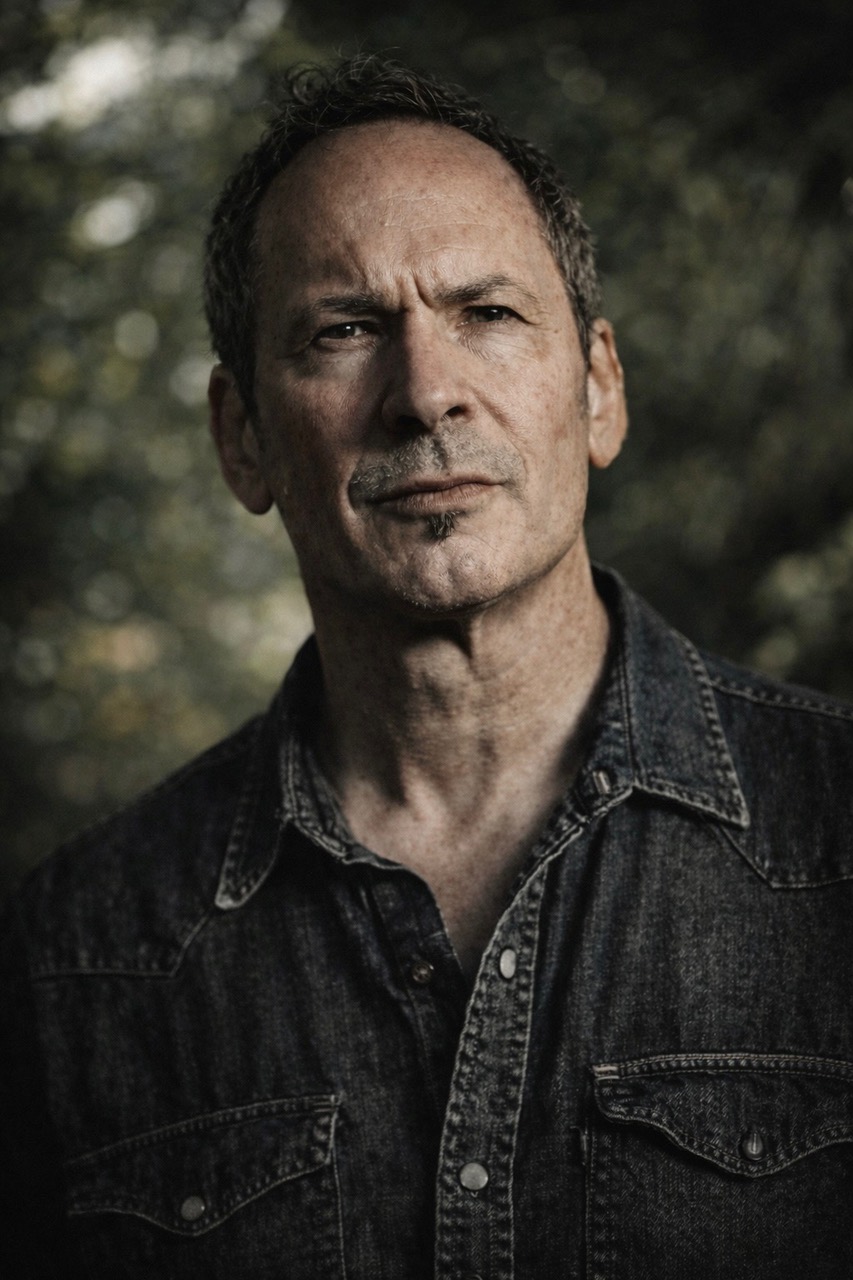
Born in the Mojave Desert, Forrest Gander is a Pulitzer Prize-winning writer and translator with degrees in geology and literature. A signal voice for environmental poetics, his work often focuses on human and ecological intimacies. His most recent book (on hiking the San Andreas Fault) is Mojave Ghost: a Novel-Poem. “Fifty-Eight Faces of California Spring” is dedicated to photographer Lukas Felzmann.
Photo of Forrest Gander by Ashwini Bhat, 2026.
//
Restaurering av natur, bevissthet og litteratur.
Vi kan ikke fullt ut forstå et fenomen eller en sammenheng om det ikke speiles i språket vårt. Kan det være slik at klimaendringene og naturnedbyggelse får skje fordi vi både gjennom språket og kulturell selvforståelse lever distansert fra naturen? Forfatternes klimaaksjon vil med prosjektet Restaurering av natur, bevissthet og litteratur invitere til en samtale om hvordan språket vi bruker påvirker vår evne til å se og skape alternativer i naturmiljøenes sammenheng.
Naturfornyelse eller rewilding betyr å la ville dyr, insekter, planter og fugler få tilbake sine habitater slik at naturen kan bli menneskets hjelp til selvhjelp. Inspirert av forfattere som Paul Hawken inviterer vi skrivende folk til å reflektere over livgivelse og rewildening som konkret praksis og tenkemåte, med spesielt henblikk på språkbruk og litteraturens rolle. Ved å sentrere livet, oppmerksomheten og omsorgen til alt rundt oss – medmennesker, fugler, dyr, planter og insekter, hav og bekker, skog og fjell – kan klimasaken nå også dem som ikke lar seg treffe av trusler og fordømming, men instinktivt leter etter gjøremåter som gir resultater og mer løfterike tenkemåter.
Utgitt med støtte fra Fritt Ord.


 KLIMAAKSJON / NORWEGIAN WRITERS´ CLIMATE CAMPAIGN // NWCC
Leave a Reply