
With a clamor of chugs, a hiss, a whine, the City leaps upward and forward, sets along the world. A strange paradise, forever snaking its way on, forever shedding, reshaping.
Take your seat amongst its denizens. You are one with the City now. Feel its ripples, its vibrations, its thrum to the tune of your heart. Does this delight you? This wonderworld of fear and delight, awash with bright lights and bright hopes and all the bright gifts this world has to offer. Bask in it. You live in the firmaments now. You live above.
It licked at your bones when you crossed, this spoken-of ascent. The border official glanced over your documents, half-hearted, as if this wasn’t upending, hair-raising. As if you, there, stepping over the bright white line as he waved, were not suddenly, all at once—lifted.
Neither then nor since have you left the ground, but it has felt like it, this ungravity. Joy, freefalling, rising in your throat. You gulp down, belly full but body free. Unburdened in the flesh, unbridled in the mind.
What they don’t tell you before the lift: cutting pain, the bitter sharpness of quick detachment. A firm, violent untangling. Stray hair plucked at the follicle; the latent throbbing after.
Welcome, said the border official, handing back your documents, his smile a totem to the City’s evergreen promise: ascension, if only with a side of severance.
Step back, to before the bright white line: over your shoulder; look, your shade, stretched out behind you. Study the shape of it, cast flat across the floor. Its manner, its form, the way it angles away, as if running, as if cowering from what is to come.
Think, before the line: No, wait. Your desire is to stay attached, to remain connected. Unfortunately, your wills and desires are insufficient. This place, its full title, is The City With No Shade for a reason.
Study the shape of it, cast flat across the floor. Its manner, its form, the way it angles away, as if running, as if cowering from what is to come.
Step forward. Feel the tug. Watch your shade wiped away, feet, then chest, neck, head. Watch the bright white line, the bright white lights, this bright white City, swallow it all.
Where do they go?
The handler the City has assigned—your seatmate, if you can call her that—is exactly like you in most ways. She dresses smartly, hair wrapped to keep things efficient. She is focused, purposeful, productive. Her ascension throbs and thrives, projects itself upon all else. Each denizen you meet will be similar, each attuned to the manner of their own lift, each projecting said lift onto the world. The way they rise from themselves, untethered, unmoored, unbegotten.
Shadeless, a state of constant uplift.
Your handler has not heard the question. Her face is buried in the screen of this vehicle, headed for the abode you’ve been assigned for the duration of your visit.
Repeat the question. Wait for her tensing, her translating.
Where do what go?
The shades.
She considers the word—shades?—then, back to the work of navigating.
What is that?
Shades?
Yes.
You don’t know what a shade is?
She angles her body, as if needing every ounce of it for interpretation.
I don’t know what you mean, she says. Perhaps you will like to try another language?
It will be like walking on air, they said about the City, when you received this assignment. And it is indeed. The rise of an untethered elevator; like floating; like takeoff with no runway, no pull of the ground below.
But not for you. No—for you, the takeoff never ends. Clutching your seat, body leaving the world, ascending but never ceasing. A balloon leaving orbit in restless rise, finding neither solace nor rest in this mythic place above. Forever thinking of the ground below, forever wondering about all that has been left behind, disappeared, by this ascension.
So, here you are, trapped in continuous takeoff.
Perhaps there are others like you, others for whom ascension is no gift, but a loss; for whom severance is not a freeing, but the start of a slow kind of grief. Perhaps you will find them, denizens who feel as you feel: that you and your shade, born into this world a pair, through it together since, belong together, however imperfectly.
The abode is as much a behemoth as the City is. Its rooms go on forever, nested one inside the other. Finding your assigned place is easy, though the way out is mazier than the way in, as if on purpose.
So, here you are, trapped in continuous takeoff.
The apartment is pristine. The bed is made; new linen. A desk, a chair, a bathroom, a bidet; cold tiles for the floor and the walls; a pair of slippers to keep the feet warm. The couch is firm, poised. You get the sense it’s never been sat on, and perhaps was never meant to.
From the full-floor window, the City sprawls below. Vast lands from every biome—arid sands; rainforest swamps; arctic icecaps; mountains, valleys, plateaus. A spiderwebbed network of conveyors between each, transferring vehicles like that in which you’ve arrived. Denizens of the City flock in the between areas, springs in their steps, lifts in their bodies. Bright, white lights in the distance illuminate it all, keep it all pristine, keep it safe and clear of shades.
In the promenade en face to your window, the visage of a supreme leader stares back. Painted top-to-bottom into the body of the structure itself. In this image, taller and wider than any being or building should ever be, he is clean-shaven, as if to ward off even the hint of a beard, a shade of sorts. Here, he is unsmiling but warm. His arms, open in welcome, stretch past the promenade, across the distance, to meet you there, in your abode, and pull you into his bosom.
You have one job, you were told, upon assignment. Go to the City, give the talk, return. It is a simple job. Everything, your speech included, has been prepared. Everyone has gone above and beyond to make this visit as frictionless as possible.
This should have been a sign of all the frictionlessness to come. From journey to arrival proceedings, all catered in this manner. Not an ounce of effort required, not a finger lifted. Food, sleep, entertainment—decadent quantities, at your leisure. Even the sights, upon arrival. Every tree a clean line, every blade of grass a right angle. From your vehicle’s window, every body programmed, every motion prescribed, every unit in mazy formation, sandflies in a dust cloud.
Standing up here, in your abode, looking down, it becomes clear: The City With No Shade is an assortment of perfect parts. Each denizen a role performer, a sword slipped neatly into a sheath. Each part specially crafted, so that the City is, in the end, a sort of model home, only the promise of a future something else.
City, noun: An amalgamation. A people Frankesteined. A storyteller; a story told. A City is a City is a City, and you are in the City, and you are of the City, and you are the City.
They tell you not to call home. Try anyway. Dial the location. Listen to the voice of the City, which regrets to inform you that you are only allowed to send messages. Would you like to leave one?
Hang up. Try again. It may be your hearing, but the City sounds insistent. Are you not listening? There is no need to call. This is as good as your home. What more do you need?
The morning of, your handler is back to shepherd you to the talk. Now that you have seen the City from above, you possess a newfound appreciation for its networks and connections, for tunnels and overpasses and biomes. Every lamplight, every sign, every piece of the puzzle delicately, purposefully placed. Hard not to marvel. Hard not to drown.
We welcome all who wish to be more, say the signs at every juncture. But more of what? Everywhere and everything in the City is already good; everything is already possible. Everything is already smooth, sandpapered edges that glide, bend seamlessly one around the other. There is no friction, no bad, no impossible. Only good; only possible.
What is more with nothing to measure against?
This impossibility of sharp, of metal edges; this complete absence of that which cuts and bleeds—this is how you know the City, all of it, is wrong.
The talk goes well. It is unremarkable. There are congratulations, handshakes and back slaps. Promises of future connection. Hazy conversations over large dinners and even larger pours. Music, dance, lights. Pleasures, fading one into the other.
All the time, you are thinking only of the City, of its filmy aftertaste, the engine oil on your tongue.
All the time, you are thinking only of the City, of its filmy aftertaste, the engine oil on your tongue.
Sleep, back in your abode, does not come easy. Not in this pristine bed with its pristine sheets and its very, very pristine wrongness.
You have one job. And yet, now that said job is done, you can only think of beauty and wrongness, of where your shade must be stored, where it rests, pressed between others; how it is marked, identified, imprinted upon. How it is retrieved when the time comes.
Shade, noun: a matter of angles. Pythagoras’ theorem, or something like it. From what height does one look? What degree is the hypotenuse? And what can one truly see if one is often adjacent, often shepherded, often shielded? What can one see when the angle changes?
On your final day with the handler, riding out of the City through a tunnel, suddenly—a puncture in the perfect, a gap tooth in the finest smile.
One panel has accidentally come loose in the tunnel wall. Traffic builds up, enough for you, for all, to stop and witness, to watch worktech scramble to hastily patch it up.
Then, only then—only in that brief moment before the worktech converge on the chink in the City’s armor—do you finally see it: a city within the City, peeking out from behind this errant panel, and from which a loud and angry groan emerges, saying: We. Are. Impossible.
Look! you say to the handler. Look—there it is!
She frowns. Where is what?
The shades! The shades!
She stares along your pointing finger, then back at you.
I do not understand, she says. Perhaps you will like to try another language?
For a long time after the City, you will dream of what you imagine—remember—of this brief moment in the tunnel, this city within, between, beneath the City. This writhing mass, pressed one upon another, squashed belowdeck, fish in a sardine. This sprawl where there is no hope, no light, no sun, only shades. This black mass, this humus foundation upon which the City rests. This hungry maw that must be fed, over and over, fuel for its strength and growth, and for which the City must procure more and more.
This sprawl where there is no hope, no light, no sun, only shades. This black mass, this humus foundation upon which the City rests.
A writhing mass to which your shade has now belonged, for however short the time. A writhing mass from which your shade, turning to you, in that moment—or in this moment, now?—says: I am impossible. Look at me—I am impossible. Look at me. Look.
City/city, noun: A gaping mouth. A red tongue; a packet of black shades pressed hard against the palate. A hoe, an excavator, a maker of empty husks and hollowed-out selves. A razor-blade flatness, offering neither heft nor thickness, neither flesh nor lifeblood. A city is a City is a city, and you are in the city, and you are of the City, and you are the city.
It licks at your bones when you cross back, the spoken-of descent. Suddenly grounded, suddenly the crunch of sand beneath your soles. All this time, you have walked on air; no more. Your body, mind, suddenly weighty again. Ascent, lift—gone.
And then, after the bright white line: over your shoulder, your shade, returning. Watch it appear, groggily: feet, chest, neck, head. Watch the bright white line, the bright white lights, this bright white City, return it all.
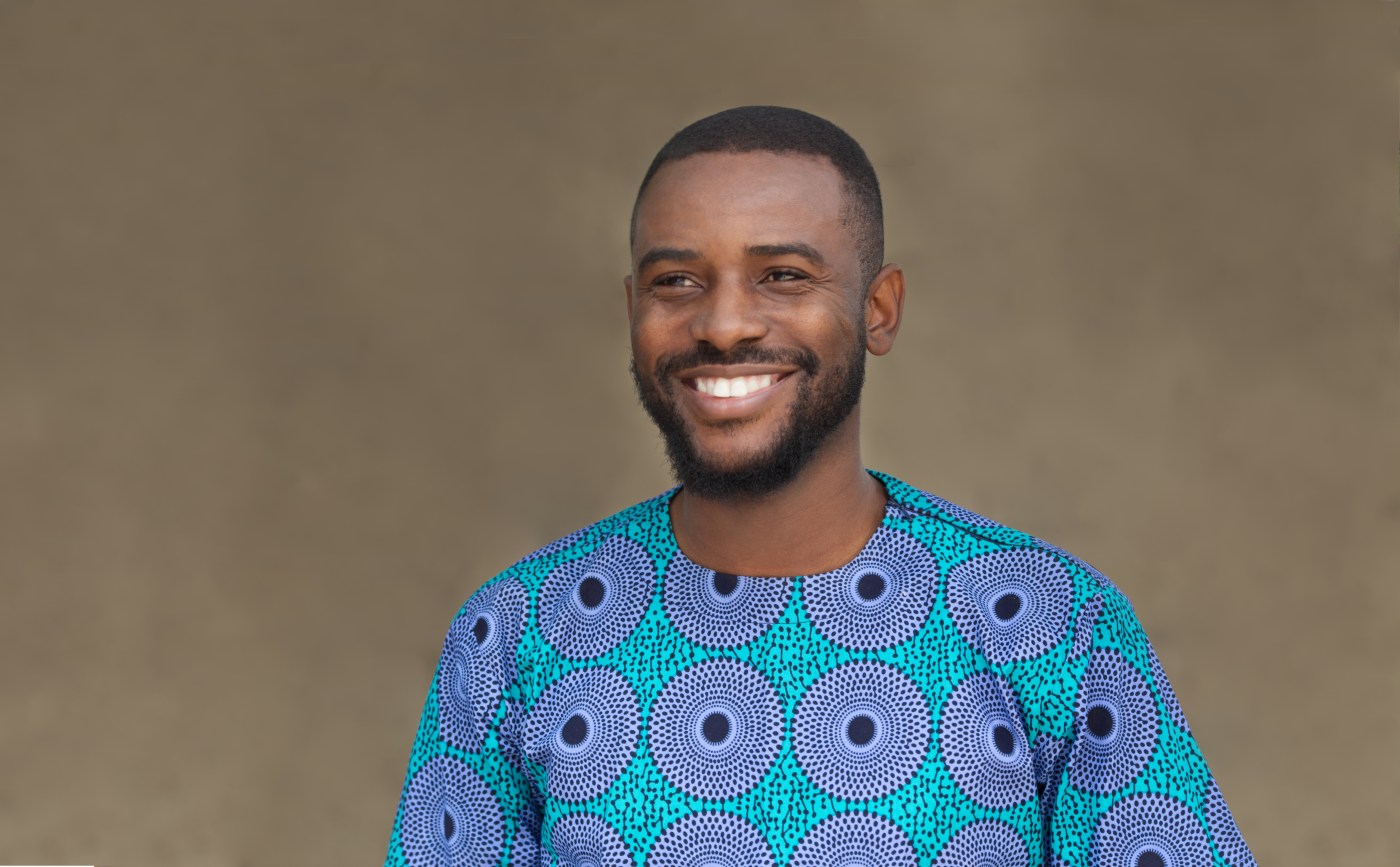
Suyi Davies Okungbowa is an award-winning author of nine novels, the latest of which are Lost Ark Dreaming (Ignyte & Nommo award winner; Nebula Award finalist), the Nameless Republic trilogy (from Son of the Storm to Season of the Serpent), and The Intergalactic Empire of Wakanda, a Black Panther novel. His shorter works have appeared in various periodicals and anthologies and have been nominated for various awards. He earned his degree in Creative Writing from the University of Arizona, and lives in Ontario, where he is a professor of creative writing at the University of Ottawa. You can find him online at @suyidavies, or via his newsletter, SuyiAfterFive.com.
Photo credit: 2019, Adaeze Opara Duncan.
//
Restaurering av natur, bevissthet og litteratur.
Vi kan ikke fullt ut forstå et fenomen eller en sammenheng om det ikke speiles i språket vårt. Kan det være slik at klimaendringene og naturnedbyggelse får skje fordi vi både gjennom språket og kulturell selvforståelse lever distansert fra naturen? Forfatternes klimaaksjon vil med prosjektet Restaurering av natur, bevissthet og litteratur invitere til en samtale om hvordan språket vi bruker påvirker vår evne til å se og skape alternativer i naturmiljøenes sammenheng.
Naturfornyelse eller rewilding betyr å la ville dyr, insekter, planter og fugler få tilbake sine habitater slik at naturen kan bli menneskets hjelp til selvhjelp. Inspirert av forfattere som Paul Hawken inviterer vi skrivende folk til å reflektere over livgivelse og rewildening som konkret praksis og tenkemåte, med spesielt henblikk på språkbruk og litteraturens rolle. Ved å sentrere livet, oppmerksomheten og omsorgen til alt rundt oss – medmennesker, fugler, dyr, planter og insekter, hav og bekker, skog og fjell – kan klimasaken nå også dem som ikke lar seg treffe av trusler og fordømming, men instinktivt leter etter gjøremåter som gir resultater og mer løfterike tenkemåter.
Tidligere artikler i serien:
Forrest Gander: Ecological Poetics as Rewilding.
Anders Dunker: Likhetens kraft på ulikhetens slagmark
Marius Timmann Mjaaland: Hyperpolitikkens natur.
Freddy Fjellheim: Vår tids helter
Anders Dunker: An Ecology of Gratitude / Robin Wall Kimmerer interviewed by Anders Dunker
Utgitt med støtte fra Fritt Ord.


